A Skin Health Series by Pani Ghadimi
When people visit me for a skincare consultation, one topic comes up almost every day: collagen.
Patients often ask how to build more collagen, which treatments stimulate collagen, or whether a supplement can replace what time has taken away. Those are excellent questions because collagen plays a vital role in maintaining healthy skin.
However, there is another important protein that deserves just as much attention: Elastin.
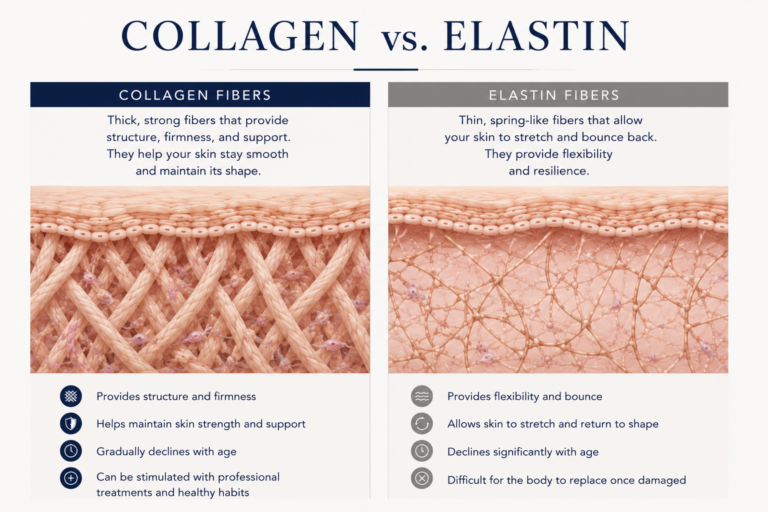
While collagen provides structure and strength, elastin allows your skin to stretch, recover, and maintain its natural resilience. Together, these two proteins create the foundation for firm, healthy-looking skin. When either one begins to decline, the changes become visible in ways many people don’t immediately recognize.
Understanding the difference between collagen and elastin can help explain why skin changes over time and why no single treatment addresses every concern. More importantly, it can help you make informed decisions about skincare, lifestyle habits, and aesthetic treatments that support long-term skin health.
Collagen has become one of the most recognizable words in skincare, and for good reason. It is the most abundant protein in the body and serves as the primary structural support for your skin.
Think of collagen as the framework beneath the surface. It provides strength, firmness, and support while helping the skin maintain its shape. Healthy collagen is also involved in wound healing and tissue repair, making it essential throughout life.
Beginning in our mid-to-late twenties, collagen production gradually slows. Research suggests that adults lose approximately one percent of their collagen each year, and that decline accelerates after menopause because of hormonal changes.
Living in Arizona presents another challenge. Our beautiful sunshine also brings year-round ultraviolet exposure, which is one of the leading causes of collagen breakdown. Even people who take excellent care of their skin can experience accelerated aging when daily sun protection becomes inconsistent.
Although collagen naturally decreases with age, it is only part of the picture.
If collagen gives your skin structure, elastin gives it flexibility.
Elastin is an incredibly resilient protein that allows skin to stretch and return to its original position. Every smile, laugh, facial expression, or movement relies on healthy elastin fibers working beneath the surface.
One of the ways I explain this during consultations is by asking patients to gently pinch the skin on the back of their hand. Younger skin quickly returns to place because healthy elastin allows it to rebound. As elastin declines, that recovery becomes slower, and the skin begins to lose some of its natural resilience.
Unlike collagen, elastin is produced primarily during early life. Once those fibers become damaged, the body has a much more difficult time replacing them. That is one reason changes in skin elasticity can become increasingly noticeable over time.
Sun exposure, smoking, environmental pollutants, chronic inflammation, and the natural aging process all contribute to elastin damage. Because of this, protecting elastin is just as important as supporting collagen production.
One of the biggest misconceptions I hear is that every wrinkle is caused by collagen loss. In reality, skin aging is much more complex.
Healthy skin depends on an entire support system working together. Collagen provides strength. Elastin allows flexibility. Hyaluronic acid helps maintain hydration. Healthy circulation delivers nutrients, while the skin barrier protects against environmental damage.
When one component begins to decline, the others are affected as well.
This is why two people of the same age can have very different skin. Genetics certainly play a role, but lifestyle, sun exposure, skincare habits, nutrition, hormones, and overall health all influence how the skin ages over time.
Rather than focusing on one protein alone, I encourage patients to think about supporting the skin as a complete system. That comprehensive approach often leads to healthier, more natural-looking results.
One of the most reassuring conversations I have with patients is explaining that skin aging is a normal biological process. While we can’t stop time, understanding what changes are taking place can help us make thoughtful decisions about prevention and treatment.
Most people begin producing less collagen in their late twenties. The decline is gradual at first, but it becomes more noticeable over the following decades. Existing collagen fibers also become thinner and less organized, making it harder for the skin to maintain its firmness and structure.
Elastin follows a different path.
Because elastin is primarily produced early in life, the fibers we have are expected to last for decades. Unfortunately, years of sun exposure, environmental stress, and normal aging slowly weaken those fibers. Once damaged, elastin is much more difficult for the body to replace than collagen.
Hormonal changes also play an important role, particularly for women. During menopause, estrogen levels decrease, which contributes to a more rapid decline in collagen production. Many women notice that their skin suddenly feels thinner, drier, or less firm over a relatively short period of time. While collagen loss is certainly part of that change, reduced hydration, slower cell turnover, and changes in elastin all contribute as well.
Lifestyle choices matter, too. Smoking, chronic stress, poor sleep, inadequate nutrition, and excessive ultraviolet exposure can all accelerate the breakdown of collagen and elastin. On the other hand, healthy daily habits help protect the skin’s natural support system for years to come.
One of the most encouraging things I tell patients is this: while we cannot completely prevent aging, we can absolutely influence how gracefully our skin ages.
Collagen loss often shows up gradually, so the changes can be easy to overlook at first. Many people assume they’re simply developing wrinkles, when in reality the skin is also losing some of its underlying support.
You may notice:
One observation I hear frequently is, “My face just looks different.” Patients can’t always identify a specific wrinkle or concern, but they recognize that their skin doesn’t appear as full or supported as it once did. In many cases, collagen loss is contributing to that overall change.
Elastin loss creates a different set of concerns.
Rather than affecting structure, elastin influences how well the skin rebounds after movement. As elasticity decreases, the skin may appear looser, softer, or less resilient.
Common signs include:
Because collagen and elastin decline together, many patients experience both types of changes at the same time. This is one reason personalized treatment plans often produce better results than focusing on a single concern.
This is one of the questions I hear most often, and the answer deserves a little explanation.
While we cannot replace the collagen we naturally produced in our twenties, we can encourage the body to produce new collagen through controlled stimulation.
That process is known as collagen induction.
Many advanced aesthetic treatments work by creating a carefully controlled healing response within the skin. As the body repairs itself, it produces new collagen fibers that gradually improve firmness, texture, and overall skin quality.
It’s important to remember that collagen remodeling takes time. Unlike fillers, which provide immediate volume, collagen stimulation happens gradually over several weeks and months. The results often look more natural because your body is doing the work itself.
The best outcomes also depend on consistency. A single treatment can certainly provide improvement, but healthy skincare habits, appropriate maintenance treatments, and daily sun protection all help preserve those results over time.
Elastin is a little more complicated.
Unlike collagen, elastin has a limited ability to regenerate, which is why prevention is so important. Protecting the elastin you already have through daily sunscreen, medical-grade skincare, and healthy lifestyle choices can make a significant difference over the years.
The good news is that advances in aesthetic technology have given us new ways to support overall skin remodeling. While many treatments are known primarily for stimulating collagen, some also encourage changes within the skin that improve elasticity and overall skin quality.
This is one of the reasons I always begin with a consultation instead of recommending the same treatment for everyone. Two patients may both be concerned about “aging skin,” yet one primarily needs collagen stimulation while another would benefit from treatments that address skin laxity, texture, pigmentation, or a combination of concerns.
Understanding why your skin is changing helps us choose treatments that make sense for your individual goals rather than simply following the latest trend.
Patients often ask whether collagen powders or supplements can replace the collagen they’ve lost over time.
The research in this area continues to evolve, and while some studies suggest certain collagen peptides may support skin hydration and elasticity, supplements should be viewed as one piece of a much larger picture.
Healthy skin depends on adequate protein intake, vitamins, minerals, hydration, hormone balance, sleep quality, and daily sun protection. Clinical treatments that stimulate your body’s own collagen production can also play an important role.
In other words, there isn’t a single product or treatment that serves as a magic solution. Healthy skin is usually the result of consistent habits combined with a personalized treatment plan designed around your unique needs.
One of the most important things I want patients to understand is that healthy skin doesn’t come from a single treatment or product.
There isn’t one laser that fixes every concern, one cream that reverses years of sun exposure, or one supplement that replaces healthy skin habits. Instead, lasting improvements usually come from combining treatments with daily skincare, sun protection, and healthy lifestyle choices.
During a consultation, I look at more than wrinkles or skin laxity. I evaluate your skin quality, texture, pigmentation, hydration, lifestyle, and long-term goals before recommending a treatment plan. While two patients may have similar concerns, the right solution is rarely identical.
Here are a few of the approaches I commonly recommend to support healthier, more resilient skin.
Laser resurfacing has become one of the most effective ways to stimulate collagen while improving the overall quality of the skin.
At The Peak Wellness Spa, we use the Helix CO₂ laser platform, which allows treatments to be customized based on your goals and desired downtime. Controlled laser energy creates a natural healing response that encourages new collagen production while improving concerns such as fine lines, uneven texture, sun damage, and acne scarring.
One of the benefits of collagen remodeling is that improvement continues after the treatment itself. As your skin heals, it gradually becomes smoother, firmer, and more refined over the following months.
Radiofrequency microneedling combines two proven technologies into one treatment.
Tiny sterile needles create controlled micro-injuries within the skin while radiofrequency energy delivers heat beneath the surface. Together, these processes encourage the body’s natural healing response and stimulate new collagen production.
One of the reasons I enjoy recommending EXION RF Microneedling is its versatility. Depending on your skin concerns, it can help improve skin firmness, fine lines, texture, acne scars, and overall skin quality with relatively little downtime.
Rather than changing the way you look, treatments like this are designed to help your skin function more like healthier, younger skin.
Professional treatments can create remarkable improvements, but what you do at home every day has an equally important role.
I often tell patients that in-office treatments are only part of the equation. Your daily skincare routine is what helps protect and maintain those results.
Medical-grade products contain higher concentrations of active ingredients and are formulated to penetrate the skin more effectively than many over-the-counter products. Depending on your skin’s needs, I may recommend ingredients such as:
Consistency almost always produces better results than constantly switching from one trending product to another.
While aesthetic treatments can make a significant difference, healthy skin reflects what’s happening inside the body as well.
Simple daily habits help protect collagen and elastin over time, including:
Living in Arizona means our skin experiences intense ultraviolet exposure throughout the year. Even on cloudy days, UV radiation contributes to collagen breakdown and premature aging. Daily sunscreen remains one of the simplest and most effective investments you can make in your skin’s future.
One of the most common questions I hear is, “Which treatment is right for me?” The answer is different for everyone.
Before recommending any treatment, I take the time to understand your concerns, your goals, your lifestyle, and how much downtime you’re comfortable with. Someone hoping to improve acne scars may benefit from a different approach than someone focused on early skin laxity, fine lines, or years of sun damage.
Age alone doesn’t determine the best treatment. I’ve treated patients in their thirties with significant sun damage and patients in their sixties with remarkably healthy skin because they’ve consistently protected it over the years.
Collagen and elastin may have different roles, but they work together to keep your skin firm, resilient, and healthy. While aging is inevitable, many of the visible changes we associate with aging can be influenced through daily sun protection, healthy lifestyle habits, medical-grade skincare, and treatments chosen for your individual needs.
One of the most rewarding parts of my profession is helping patients understand why their skin is changing. Once you understand what’s happening beneath the surface, choosing the right treatment becomes much less overwhelming. Instead of chasing the latest trend, you can make informed decisions that support your skin’s health for years to come.
Healthy skin isn’t about looking like someone else or trying to turn back the clock. It’s about helping your skin function at its best so you continue to look like the healthiest, most confident version of yourself.
If you’re ready to better understand your skin and explore treatments that support long-term skin health, I’d love to help you build a personalized plan that’s right for you.
Pani Ghadimi is a Licensed Aesthetician and Laser Technician at The Peak Wellness Spa with nearly three decades of experience helping patients improve skin health through personalized treatment plans and advanced aesthetic technologies.
Through the From the Treatment Room series, Pani shares the science behind healthy skin, explains the treatments she recommends most often, and answers the questions she hears every day during patient consultations. Her goal is to make complex skincare topics approachable, empowering patients to make informed decisions about their skin at every stage of life.
Collagen provides your skin with structure, strength, and firmness. Elastin gives your skin the flexibility to stretch and return to its original shape. Healthy skin depends on both proteins working together.
Most people begin producing less collagen in their mid-to-late twenties. Production gradually decreases over time, and the rate of loss often accelerates after menopause because of hormonal changes.
While you can’t replace the collagen you naturally had when you were younger, treatments such as laser resurfacing and RF microneedling can stimulate your body’s natural collagen production. Results develop gradually as new collagen forms over time.
Elastin has a much more limited ability to regenerate than collagen. Although damaged elastin is difficult to replace completely, protecting existing elastin with daily sunscreen, healthy skincare habits, and appropriate aesthetic treatments can help support healthier, more resilient skin.
Research continues to evolve. Some studies suggest certain collagen peptides may support skin hydration and elasticity, but supplements should be viewed as one part of a comprehensive skincare plan rather than a replacement for healthy lifestyle habits or professional treatments.
Several aesthetic treatments encourage collagen production, including laser resurfacing, RF microneedling, microneedling, and other collagen induction therapies. The most appropriate treatment depends on your skin concerns, goals, and desired downtime.
Daily sunscreen is one of the most effective ways to protect both collagen and elastin. A consistent skincare routine, balanced nutrition, quality sleep, avoiding smoking, and limiting excessive sun exposure all contribute to healthier skin over time.
If you’re noticing changes in your skin but aren’t sure what’s causing them, a personalized consultation can help identify the factors contributing to those changes. Together, we’ll evaluate your skin, discuss your goals, and create a treatment plan designed specifically for you.
Schedule a consultation with Pani at The Peak Wellness Spa and discover the treatments that best support healthy, resilient skin.

Blending science & nature to promote wellness.
Discover the breakthrough Ultra+ with DE|RIVE® serum for healthier, fuller hair.
Event only pricing • Raffles • Limited seats